Wednesday, 24 July 2013

On Royal Spawn

I briefly considered feigning satisfaction and withholding this post, but I feel I've already passed the age at which I'd be inclined to follow popular opinion in order to gain favour. Besides, the weather is propitious for sedition.

Kate Middleton has just emitted a baby and so, naturally, people queued up everywhere to... Well, to what? To be in with a chance of winning the afterbirth? To sniff the umbilical cord? To get a free MP3 recording of the event (99p on iTunes)? Most people probably got to the palace and said, 'Shit, what are we standing here for?' as if being tugged from out a quixotic but venomous dream. 
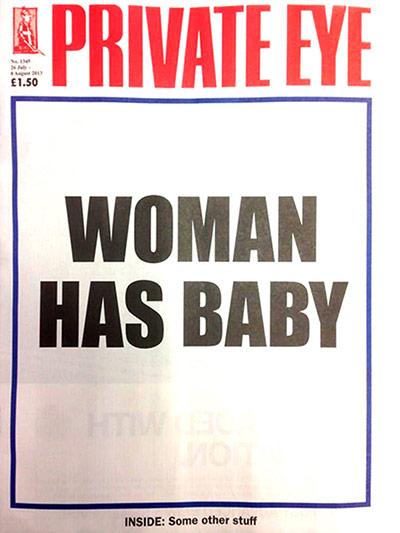
Private Eye's front-page coverage. Brilliant.

There are a few things that are genuinely saddening about this media-induced fervour. Firstly, when you look on a crowd of people waiting outside Buckingham Palace, you can almost know for certain that these people wouldn't do the same even for a friend's childbirth, such is the power of media nonsense. Do these people really care about a baby that has just been born into an archaic, deeply unfair system? If so, why? I would submit that it is almost entirely media fabrication. 'Care, care, care!' the papers scream, lest you look like some sort of social terrorist. 'Just fit in!' I think most people go along with it without questioning what the hell they're subjecting themselves to, and what their incurious (spellcheck suggested 'injurious', a word that would fit with equal ease) decisions say of their whole being. I do not think it is exaggerative to say that the media is responsible for whipping up interest where it would not have existed to an even comparable degree.

What is interesting, but deeply unsettling, is that in the past monarchs have had to maintain a huge reserve of force to legitimate their reign. Nowadays, in the world of the internet and mass media, the monarchy has become a branding exercise. Why is this worse? Well, a monarch that can best manage an army is a monarch that can best defend the country, and in this way they perhaps deserved in the past at least some of their position. Presently, however, the royal family secures its future position with what is effectively deception, as all branding is. It is propagating the idea that a population needs something more than it really does. It is incredible, simply incredible, that our current royal family has such support from the public (though I do not pretend it is quite as strong as the media might have you believe). They contribute nothing to the people by whom they are largely funded. The poor souls of this country pay for a family to live in a palace. They actually have to be paid to submit themselves to such degradation. The whole thing is farcical. Worse, they are completely unelected and nobody seems to mind.

And then you have David Cameron taking it upon himself to decide that the whole nation 'will celebrate'. How loathsome. I wouldn't particularly mind others celebrating the birth of this child (one of the correspondents on BBC News said 'Kate has given birth to a young child,' as if she might have given birth to a 43-year-old Bulgarian window cleaner), but I cannot tolerate others telling me that I must titillate myself in glee. 'Nobody's got any money, most people can't afford to have fun, the world's about as hostile as it has ever been, but an ancient mechanism for oppression and greed has just been perpetuated. Wooooooo!'

It is the ideas underpinning this unquestioning acceptance of the royals that are most damning. It says the people of this country do not mind a deeply unequal society, and the monarchy is the keystone in the idea that it's OK for some people to live comfortably by exploiting others. It says we do not mind the deification, the beatification, the media wants us to bestow on the unworthy. I would suggest that to agree that these people are better through a happy accident of birth is the ultimate in self-abasement. It is an acceptance of one's own servility, in fact a resignation to it, and furthermore a rejection of talent or endeavour. I do not need to tell you that this is toxic to society and the individual alike.

Why else do I despise this simulated interest in the royal hatchling? I alluded to it earlier, but it is this: there are already people in everyone's life, real people with whom we actually have spoken, it can be guaranteed, who deserve more attention than they receive, and it is tragic that they are not praised because they are not in the media. Don't worry about babies you will never meet, whose lives are blessed by virtue of no virtue at all. Celebrate what's real and take an interest in someone the papers haven't told you to take an interest in. The Duke and Duchess of Cambridge don't care about you, won't be at your wedding, won't send you a Christmas card, and you should return the favour. Think for yourself and decide who is more deserving of your time - royalty in palaces, promoted to a mystical celebrity status, or friends. 

Tuesday, 16 July 2013

Sonnet 94 by Shakespeare

They that have power to hurt, and will do none,
That do not do the thing they most do show,
Who, moving others, are themselves as stone,
Unmoved, cold, and to temptation slow;
They rightly do inherit heaven's graces,
And husband nature's riches from expense;
They are the lords and owners of their faces,
Others but stewards of their excellence.
The summer's flower is to the summer sweet,
Though to itself, it only live and die,
But if that flower with base infection meet,
The basest weed outbraves his dignity:
For sweetest things turn sourest by their deeds;
Lilies that fester smell far worse than weeds.


I am particularly fond of this sonnet because I was, at the time of reading it, having similar thoughts. Whilst I have no doubt that Shakespeare is not referring to the legal system, I feel the poem can still be interpreted as such. I was contemplating the law and how, whilst of course stymieing the intentions of criminals, it also makes the task of discerning the villainous from the virtuous more difficult for the everyday person. Criminals, who would with absolute freedom have killed or raped or stolen a 4B pencil from the local art merchant, under the law adopt the appearance of a virtuous person. Whatever one's morality, one is shown to be moral by abidance to the law. Of course, I'm not advocating the punishment of thought crime, but it did seem to me that those who are acting morally only for fear of retribution and personal plight should be considered less virtuous than those who acted morally regardless of the law. It is more commendable to express restraint of one's own volition than to express restraint under the fetters of judicial edicts. I absolutely detest cliché unless used ironically or comically, but the law effectively proffers wolves sheeps' clothing. Whilst you may say that this not much matters, for they cannot act on these villainous impulses under the law, I would postulate that a willingness to act immorally must taint every aspect of a person's character. It is legal, for example, to continuously act selfishly, and almost every illegality imaginable involves a heaped spoonful of selfishness. Having been proactively debarred from homicide (I am using one of the worst crimes in order to make the argument clear, most offenders of course are not murderers), this does not stop someone from being a general arse. I would rather not associate with those who are letting me live only because of the law. 

After that fairly circuitous segue, another interesting thing about this poem is that its sentiment is later appropriated, knowingly or not, by J. K. Rowling. She writes in one of the Harry Potter books: 'If you want to know what a man’s like, take a good look at how he treats his inferiors, not his equals.' I was going to find out exactly which Harry Potter book this comes from, but I fear even J. K. Rowling would not be able to summon a dissimulation of interest if I were to waste the time doing so. Apropos, I don't think she was consciously channelling Shakespeare, but it's quaint how it seems nobody can escape his yoke. 

Spiffing, boffo, copacetic, frabjous and all that. I have no more to say. I suppose it doesn't readily occur to me, though perhaps it should, how absolutely egoistic it must seem - and is - for me to direct attention away from a Shakespeare sonnet and towards my own witterings. I have far exceeded his 14 lines and still if this was a job interview he would have the job before my interview had finished. Quality over quantity, eh. 

Monday, 8 July 2013

On Grammar Nazism

It is too hot. I do not refer to a subject in that sentence because I don't feel I need to reference one. Everything is too bloody hot. I do not appreciate the sensation of being sautéed, much less without judicious seasoning. And so the nonsense has already begun to emerge. I can't help it. Anyway, the heat today is such that I am occupied only by imagining waxwork exhibitions around the country being reclaimed by force by nature, Simon Cowell's oblong bonce bubbling and weeping to the ground in a cascade of simulated flesh, followed swiftly by his liquified mammaries as feckless museum staff rush to recover the atrophied mass. This is all perhaps a hyperbolic assessment of the weather but I feel it accurately describes my own state of discomfort.

It is the anger precipitated in me by this heat that leads me to the savage tirade that is about to ensue. This is a topic that has been clawing at my insides for quite some time and it, perhaps wrongly, continues to disgust me in the greatest way possible. The phenomenon is that of the ruthless grammatical pedant. It even has a popular term now, and the Grammar Nazi movement boasts a huge membership. I will propose in this blog post that these people can all go and, for want of a better expression, fuck themselves (or as Christopher Hitchens so elegantly described this phrase, 'attempt an anatomical impossibility.')

I cannot possibly recall how many times I have seen arguments - naturally on the internet, where one is granted a certain degree of both anonymity and physical distance - which run smoothly and appear to be coming closer to an approximation of truth, when someone will misspell something or make a mistake with a completely insignificant piece of grammar and will be absolutely pilloried for it. I cannot describe how speedily this infuriates me. Correcting someone's grammar in this way, with the wicked intent to generate embarrassment, is seen as socially acceptable. People for some reason think it either validates their argument, or rather devalues their opponent's, or creates comedy. It does neither. In fact, the ridiculous incursion of grammar into every fucking argument has precisely the reverse effect on the buffoon who feels their argument is so poor that they must make recourse to grammatical, personal jibes. Their argument suddenly looks anaemic, in need of extraneous aid, and their disposition is highlighted as one lacking humour, creativity, tolerance, or disobedience.

Perhaps one reason for my abomination of this blasted habit in argument is that I don't like to be criticised. This perhaps is true, though I rarely voluntarily sit in the company of people liable to deploy this non-sequitur. The inference is what really aggravates me - the inference is: 'Your grammar has failed, therefore the reason behind your argument is undermined.' I fail to see the logic here.

An additional reason for my hatred is that I cannot bear to be corrected, or see someone corrected, by someone else who is not at all perfect in the subject they so mightily preach on. This is sanctimonious, greasy foul play. People should not have to feel that a typo, or even deliberate error, will derail an argument.

More importantly than this - who cares? Why does it matter that your adversary omitted an apostrophe? Argument is not an editorial submission; at least, not an editorial submission with regards to grammar. The focus of an argument should be on the underlying principles. As long as you can marshal your thoughts in a comprehensible way then you should not be penalised. In trifling debates on the internet, grammar should not determine truth.

I don't think grammar has ever been as zealously praised as it is today, and I've lost count of the amount of letters or manuscripts of past poets' works I've seen that have omitted apostrophes and such. Perhaps it bespeaks fault on my part but I don't find this offensive and I don't judge any party for it. I make reference to him in every blog post but I'm not tiring of it so I'm going to recidivate... Byron was one of the most literate people who ever lived and he very frequently abbreviated or omitted punctuation in his letters. This was done largely for economy - it was expensive to send long letters in the 1800s (a state we are returning to...) and grammar could easily be compromised if meaning remained intact. This is analogous to Twitter with its character limit. And this brings me to a similar point, which is that some people patrol Twitter in the most pathetic way imaginable, trawling through tweets and highlighting poor grammar for 'comedy'. I follow, or rather did follow, someone who used to enjoy doing this, who said he 'searched for common spelling and grammar errors' for material. I found a great empathy for an existence as tragic as his must be. To highlight a grammatical error in an argument is one thing, but to spitefully do this on Twitter, which is itself a place for nonsense and frivolity, is quite another.

Here we reach a crucial point which is ineluctably damning for the advocates of - actually, I refuse to refer to invoke its idiotic appellation any longer - Grammar Land jingoism. Namely, does poor grammar, through mistake or otherwise, indicate a lesser intellect? If yes, then you are simply mocking those above whose intellects you would place your own, which is malice. There is no place for malice in equanimous debate, and a lesser mind does not necessarily mean lesser beliefs besides. If no, then why bother to bring the point up at all? It cannot possibly outline a weakness in the argument's author.

I could go on about this for too long, but I feel I would be emulating the misplaced ardour against which I fulminate. Correcting grammar to win an argument is counter to promoting reason, and correcting grammar for no reason besides maleficence is counter to promoting kindness. This habit calls upon all of man's worst vices - superiority, spite, sadism, and a desire to win at all costs. Do not mistake my position on grammar itself - it is useful in the same way as mathematical notation, but poor mathematical notation says nothing of the mathematical principles underpinning the work. I try to use good grammar when I can but I won't go out of my way to correct others in their use of it. To correct either ignorance or error is equally unkind. I am no editor and no teacher. And I certainly will not substitute prissiness for reason. 

Tuesday, 2 July 2013

Lines Written beneath an Elm in the Churchyard of Harrow by Lord Byron

Spot of my youth! whose hoary branches sigh,
Swept by the breeze that fans thy cloudless sky;
Where now alone I muse, who oft have trod,
With those I loved, thy soft and verdant sod;
With those who, scatter'd far, perchance deplore,
Like me, the happy scenes they knew before:
Oh! as I trace again thy winding hill,
Mine eyes admire, my heart adores thee still,
Thou drooping Elm! beneath whose boughs I lay,
And frequent mus'd the twilight hours away;
Where, as they once were wont, my limbs recline,
But, ah! without the thoughts which then were mine:
How do thy branches, moaning to the blast,
Invite the bosom to recall the past,
And seem to whisper, as they gently swell,
"Take, while thou canst, a lingering, last farewell!"

When Fate shall chill, at length, this fever'd breast,
And calm its cares and passions into rest,
Oft have I thought, 'twould soothe my dying hour,--
If aught may soothe, when Life resigns her power,--
To know some humbler grave, some narrow cell,
Would hide my bosom where it lov'd to dwell;
With this fond dream, methinks 'twere sweet to die--
And here it linger'd, here my heart might lie;
Here might I sleep where all my hopes arose,
Scene of my youth, and couch of my repose;
For ever stretch'd beneath this mantling shade,
Press'd by the turf where once my childhood play'd;
Wrapt by the soil that veils the spot I lov'd,
Mix'd with the earth o'er which my footsteps mov'd;
Blest by the tongues that charm'd my youthful ear,
Mourn'd by the few my soul acknowledged here;
Deplor'd by those in early days allied,
And unremember'd by the world beside.


It's almost 6am as I begin this post, and I have, as is customary for those with no commitments to uphold, spent the early hours of the morning watching James Bond movies. Quite enjoyable really, I had no idea softcore pornography could involve so many fight scenes and acts of escaping. Teleshopping propaganda, currently espousing some fascistic expandable hose device, now runs unbidden across my peripheral vision. The natural denouement to such a morning is of course to post about a 19th century poem on the internet. 

This poem was written by Byron at the age of 19 which, being a familiar age, naturally invites some degree of comparison between him and me; I regret to say that the contrast does not portray me in any favourable terms. He really must have been insufferable at school. 'Yes, sir, the passage of Milton you gave us was strong but I have made several emendations which, I'm sure you'll grant, free the text from its deficiencies.' Perhaps he wouldn't be this loathsome but certainly he was not ashamed of his talents, and his ironically-titled Hours of Idleness, from which this poem is taken, includes many imitations of great ancient poets such as Catullus. And all of this before the close of adolescence - I, conversely, am fortunate if I remove myself from bed by 4 in the afternoon. 

All the typical Byronic motifs are here - lament, wistfulness, and a heavy acknowledgement of ageing, to name but a handful. What fascinates me is that by the age of 19 Byron had already set the mould with which his future poetry would be cast (perhaps before this, one might argue). We even have several Romantic, orgasmic outbursts such as 'oh!' and 'ah!' which I always find amusing. I hope he did not make such noises while writing the poem at Harrow. Always inadvisable around schools.

Right-o, I'll happily shut up now. I need to sleep and your eyes need a reprieve. 

Wednesday, 26 June 2013

The Paradox of Industry

You may, if you care, which itself would grant you membership to a very elite group, have noticed that I haven't posted anything for a week or so. This has not been a contrived endeavour on my part, in fact it has been due to the absence of such an endeavour. I've discovered, since returning home a fortnight ago, an ungovernable torpor which has left me unable, unwilling, unwhatever to write much at all. As it happens, I decided quite some time ago to write about writer's block and I have, in a display of grandest irony, been unable to complete it.

Fortunately, an hour's perusal of Twitter generously endows one with ideas, and is as efficacious as anything you could care to mention in restoring my unfaith in humanity. This has gone some way in placating the gaping abysm of creative desolation into which I am happily lodged. Hopefully, therefore, I will be able to moan about something fairly soon.

But enough self-indulgence, I must apprehend the crux of this post. What I have found to be true in this span of unimpaired leisure is that industry is exponentially harmed by any gift of free time. I have always suspected this to be the case but my summer holidays affirm it. This may be a rule true only of myself, but this does not diminish its claim to being a rule. I find I will complete far more, write far more, enjoy myself far more, when all this is tempered by unpleasantness. I recall writing a lot during sixth form, from 1am onwards when I had to be up at 8am, which fact oppressed me greatly. It is only against the backdrop of something toilsome that leisure can be efficiently appropriated. Now I have no countervailing force against which I should rebel, and this somehow removes most of the point of writing anything in the first place. At university there is a kind of sour joy to be had from missing a day's lectures to relay a soldier's experience of how shit the whole arrangement is. Prioritising writing before coursework provided a similar simulation of sybaritism and debauchery. Now I am, as a teacher might remind me, only wasting my own time. Wasting others' is far more enjoyable.

I do not merely propose that excessive spare time reduces output per hour of spare time, but that it may reduce total output itself. Certainly I have done a lot less in the last two weeks than I usually might, but I've also strangely derived less pleasure from this. I do not much savour the hours I spend in my pyjamas, watching television shows that I would, under normal service, vomit at the sight of. I cannot understand why I prefer to do boring things than interesting things, when both are as accessible. A sort of anti-utilitarianism seems to reign in my head when I'm given enough spare time.

Clearly, though, this cannot be a universal truth - this would imply that less can be accomplished in an infinite time frame than in a nonexistent one. But I do think there is an optimal balance between work and leisure. Furthermore, as I described in my last post, a large amount of the creative output of the past few hundred years has been the progeny of a life of leisure. This said, we do not know what could have been produced had these idle writers been afflicted with greater hardship. I can create things when I have a lot of free time, but there is no sense of urgency.

I suppose it can be said that leisure is a great milieu for thought, but I find that too much leisure produces too much thought. Sometimes I envy the feral nonchalance with which an animal can drift through the world, programmed as they are merely to find the next meal. Human minds are like furnaces, things need to constantly be poured into them or they will collapse under their own ferocity. If the mind cannot deconstruct something external then it will look into itself and begin to mess around with levers and switches that are best left alone. A mind will eat an arm if it must do so to survive. Leisure gives too much time and too little to use it for. So too much leisure is bad in this respect.

Anyway, the point I wish to make from all this is: sometimes there can be too much of a good thing. Excessive leisure may not be quite so deleterious to others, but I find it removes any sense of struggle. I like being irritated, and this often compels me to do things I do enjoy, and this is not so viable when I am the cause of my own boredom (though I have made a good attempt at it in this post).

Monday, 17 June 2013

A Satyr against Reason and Mankind by John Wilmot

I'd be a dog, a monkey, or a bear,
Or anything but that vain animal,
Who is so proud of being rational.


The following is just an excerpt from this charmingly bitter poem by John Wilmot. The full text can be pursued with little exertion by clicking on the link which I will beneficently provide: http://andromeda.rutgers.edu/~jlynch/Texts/mankind.html

Were I (who to my cost already am
One of those strange, prodigious creatures, man)
A spirit free to choose, for my own share
What case of flesh and blood I pleased to wear,
I'd be a dog, a monkey, or a bear,
Or anything but that vain animal,
Who is so proud of being rational.
   The senses are too gross, and he'll contrive
A sixth, to contradict the other five,
And before certain instinct, will prefer
Reason, which fifty times for one does err;
Reason, an ignis fatuus of the mind,
Which, leaving light of nature, sense, behind,
Pathless and dangerous wand'ring ways it takes
Through error's fenny bogs and thorny brakes;
Whilst the misguided follower climbs with pain
Mountains of whimseys, heaped in his own brain;
Stumbling from thought to thought, falls headlong down
Into doubt's boundless sea where, like to drown,
Books bear him up awhile, and make him try
To swim with bladders of philosophy;
In hopes still to o'ertake th' escaping light;
The vapour dances in his dazzling sight
Till, spent, it leaves him to eternal night.
Then old age and experience, hand in hand,
Lead him to death, and make him understand,
After a search so painful and so long,
That all his life he has been in the wrong.
Huddled in dirt the reasoning engine lies,
Who was so proud, so witty, and so wise.
   Pride drew him in, as cheats their bubbles catch,
And made him venture to be made a wretch.
His wisdom did his happiness destroy,
Aiming to know that world he should enjoy.
And wit was his vain, frivolous pretense
Of pleasing others at his own expense.
For wits are treated just like common whores:
First they're enjoyed, and then kicked out of doors.
The pleasure past, a threatening doubt remains
That frights th' enjoyer with succeeding pains.
Women and men of wit are dangerous tools,
And ever fatal to admiring fools:
Pleasure allures, and when the fops escape,
'Tis not that they're beloved, but fortunate,
And therefore what they fear, at heart they hate. 


I only discovered this poet a while ago, but I consider myself fortunate in having done so. He was a contemporary of the more famous Andrew Marvell, and was a courtier of Charles II's court during the Restoration. His full title was John Wilmot, 2nd Earl of Rochester. As it happens, he rather impressively died of venereal disease, and a play attributed to his name is called Sodom, or The Quintessence of Debauchery, which I think is a staggeringly good name. What I find so fascinating about him though, and this seeming contradiction is evident in this particular poem, is that he was writing in the Enlightenment era but seems to write in a completely Romantic fashion. Many would attribute the beginnings of the Romantic era to Blake but perhaps John Wilmot is a candidate. I noticed quite soon that Wilmot refers to man as a 'vain animal'. Byron would later refer to man as 'man, vain insect!'

Wilmot espouses so many Romantic shibboleths in this poem that you would be forgiven for thinking it was written 200 years after it was. There is the love of nature, the rejection of reason, and the propulsive device of subtle misanthropy that is so characteristic of writers such as Byron. There are so many quotes I could isolate to aid me in this conclusion, but this is perhaps the most potent:

'His wisdom did his happiness destroy,
Aiming to know that world he should enjoy.'

These are complaints that writers such as Poe would later express. In fact, in Poe's Sonnet to Science, Poe writes (if I remember correctly): 'Why preyest thou thus upon the poet's heart,/Vulture, whose wings are dull realities?' He then goes on to write about how mythology, fantasy and frivolity are crushed under the weight of reason. This is the sort of point Richard Dawkins faces on a regular basis - people ask him questions such as 'Doesn't religion give people a more palatable view of the world?' and he will reply very astringently with 'You may prefer it, but that doesn't make it true. Besides, science is infinitely more fascinating.' Part of me does agree with this, and science is fascinating, but recourse to fantasy can be salubrious to the troubled soul. Part of me wishes I could be so constructed as to believe simpler explanations of the universe. Diplomatically, I think a synthesis between reason and instinct should be encouraged - it would be terribly dull to live every waking moment in a very matter-of-fact way, but it would be an affront on man's potential and the splendour of nature to spend all of one's allotment in a chrysalis of ignorance. This is one reason I dearly hope religion is not completely eradicated by atheism. Even Christopher Hitchens, an antitheist, admitted this - it is the struggle between reason and fantasy that drives man to the better construction of each. 

I hope that was not too great an excursion. In short, I think this is a very important poem. Apart from this, though, it is impeccably written. 'Reason, an ignis fatuus of the mind,' must be one of my favourite lines of poetry. It is possibly the shortest summary of the Romantic movement I have encountered. I can almost overlook the massive injustices inherent in the aristocratic, feudal nature of the times if the aristocracy were producing writing like this (I'm not sure the composition of the country is too different now, however.) Bertrand Russell makes the point in In Praise of Idleness that most of humanity's philosophical, literary, mental advances have been as a result of the leisure afforded to the wealthy, though this is not a recommendation for an unencumbered minority but an unencumbered majority. The unjust wealth of kings brought hundreds of years of feudal oppression, but it also brought incredible writing, music and architecture that would probably never have been produced under today's capitalism.

Wilmot makes it clear that these chains of reason are of man's own construction, reminding me of Blake's 'Mind-forg'd manacles'. 'Mountains of whimseys, heaped in his own brain' is a great quote that exposes man's departure from nature. The final line of the poem, not included above but equally frandibulous is 'Man differs more from man, than man from beast,' the point being that artificial ideology and such removes us from our natural state. I just adore this poem. Read the full thing and bask in its brilliance.

Wednesday, 12 June 2013

Returning from University

I vowed to never mention my own personal circumstances on this blog, or at least never to employ them as the basis for an entire post, but I am about to flaunt this rule, I'm sure enraging the thousands of readers who eagerly follow my impersonal posts in the process. This blog post is a necessity because, as I believe is a common phrase among today's youth, I am presently desirous of a bitch.

Well I've finished my first year at university (I must take a minute here to assail an annoyance - why must people write 'University' with a capital letter? But then I suppose we do all go to School and visit the Library and use the Toilet. I find the whole affair rather sinister - University gives the impression of a grand international institution bent on world domination, which aspiration I'm not sure I advocate. If I wrote that I'd just returned from the Cupboard the absurdity would be immediately conspicuous. The capitalisation would suggest that the cupboard was some sort of significant figure in the house, who might dispense Kit-Kats only upon the pursuance of the cupboard's whims) and I'm thoroughly underwhelmed. I'm going to write something more comprehensive, and have begun to do so, but I'm not entirely sure whether I'd like to post it yet. Coupled with this is a sort of authorial constipation which currently haunts me, under whose tyranny I either produce nothing or something which Gillian McKeith might turn her nose up at. The mere presence of words in this blog post indicates which camp this prose occupies.

There is something - to me at least - terrifying about moving to or from university. I don't like the change of scenery as much as my mind tells me I ought to. Disequilibrium reigns for the first few days and then an irrepressible dolour sets in, regardless of the direction of the journey. It seems I am able to lament the loss of the positive aspects of the dwelling I have just vacated, but not consider the forgone negatives. However disgruntled I am in the one location, and it is usually just a question of how disgruntled, moving serves only to exacerbate my disaffection. After this it is a process of becoming inured to my surroundings until I must be unearthed again. The result is that I am reluctant to ever engage in translocation.

Furthermore, it's sickeningly hot and my sympathies are largely with the poor people who inhabit a country hotter than ours. My dislike for the sun has been variously attributed to vampirism, reclusiveness and natural contrarianism, but I don't think there's anything that difficult to comprehend. Summer is the season of sweat, of discomfort, of people being nauseatingly happy for no reason but that the nuclear reaction in the air is incinerating us at a quickened pace.

I now have four months in which to languish in my house, and I feel more than ever an urge to seek employment. The sad truth, however, is that I cannot see myself exerting any energy in acquiring a job.  The idea of being a serf is unappealing enough, without the added mortification of having to beg for it.

Anyway, this really has been a pointless ramble, partly committed in order to prove I'm still around and partly for my own selfish purposes. More poetry when I'm feeling perky. Good riddance.