I have just finished the task of eating chips. This is a fact, and any attempt to prevaricate on the matter will I'm sure result in greater ramifications in the future. I should clarify to you the nature of these chips, however. These are chips of the potato, not the poker, variety, and they are certainly not of the computing variety. To eat computer chips would be dangerous, unsatisfying and counterproductive to man's technological development.
This fascinating twist in events began with the recognition that, having quite literally no food in my possession of any sort (I did consider gobbling down a batch of vitamin C pills, I must confess), I decided something must be done to placate the faint corrosion in my core. Impelled by the monopolistic market conditions obtaining in my immediate vicinity in the early hours of the morning, I decided to bite the bullet - though at the time I did not realise this metaphor would soon attain not only a figurative but a literal validity - and make my spindly way to the resident tub of grease.
The horror of which I speak is a kind of locomotive purveyor of any foodstuff - any foodstuff that is liable to cause premature heart failure, I should add. It sits, static and brooding, much like the trapdoor spider from which it takes its inspiration, cloaked in innocuous sheets of metal whilst secretly harbouring its invidious fare, which it hurls on passing drunkards in the pursuit of its capitalist ambitions.
OK - this is all unimportant, one might assume, because the food at such places is inexpensive. I thought so too, until I was forced, by my unhelpful inability to refrain from purchasing things once in a spider's nest, to spend two of my finest, British, fair and just pounds sterling on what can only be described as a Pandora's box of plant derivation. I was quizzed of an evening by a stern man as to whether I would prefer my chips to be salted and vinegared. I acceded to his kind offer - though little did I know it was an involuted masking procedure, designed to screen from my disgust the horrors of the shambles (to quote the immortal Shelley). Having sprayed this arachnidian admixture upon the polystyrene casket in which my culinary hopes were inhumed, he passed the time bomb to me and pocketed my two pound coin, the outer ring of which adopted, in that exchange, a halolike and transcendent quality. Much like a blacksmith pacifying the beauty of a throbbing brand, he submerged the weeping coin into the innermost recesses of his infernal attire, and an audible hiss of anguish erupted from the depths.
I shall now essay to assay the quality of these chips. Drowned in this sickly emiction, which to me was entirely redolent of Marmite and suppurating cheddar, sat an extremely dejected bunch of hollowed-out witchetty grubs (one of these, I found to my horror, was not properly emptied), looks of futility seared into their squashy aspects, as if to convey some immense disappointment at the fact that their lives amounted to this - the production of low-grade potato substitute. The taste was comparable, again, to that of Marmite and suppurating cheddar, and the texture brought a yielding decomposition to the party. I felt as if the demoniac figure from behind the counter had conferred on me the gift of cannibalism, and here I was snatching up little humans from a regrettably-hued allotment and grinding them between my terrific maws. I took great joy in shearing the starchy, foul integuments from their hosts and sanctioning the resident souls to the various rings of hell. 'Gluttony for you, my child! I hope you enjoy eternal privation!' I cry, cackling wildly and spilling the untried upon the floor of my burning chamber. 'I will deal with you later!' I gobble, convulsing in sheer joy. I am Minos, I have unquestionable power, I am sovereign in this realm.
Look, I have no problem with paying two pounds for some decent food. I have done so in the past, and I daresay I will venture to do so again. But two pounds for this necropolitan oddity? Two pounds? Two pounds?! I pay less than that at a proper shop, with legitimate costs to factor in. In stark contrast, what I was dealing with now was effectively a frying pan on wheels. Where are the overheads? Are furry rear-view mirror dice tax deductible? Was this the most inefficient business the world had ever seen? I wondered whether perhaps, in the bowels of one of the fryers, a highly-skilled cadre of ferrets, on generous salaries with free private health care, curated a collection of fast food memorabilia. Rudimentary spatulas, rusted pans and soiled aprons would lie preserved in state, depending from above in solid gold cages, like royal prisoners.
Lastly, I have spoken of the quality of these foul digits but I have left the subject of quantity unforgivably neglected. I can only say of the portion handed to me that it was the atom of the food world, the smallest possible division of anything such that it can remain edible to the human race. Luckily for me, I happen to have a laboratory-grade photon microscope in my room, and was able to locate my meal in under four hours, placing it neatly over two grateful taste buds.
I now sit here, all sullen and impecunious, gazing on the polystyrene, erstwhile host of those blasted things, and I am being fondled by the strange urge to lift the vessel to my face and devour it utterly. The scent is far more agreeable than that of the charge contained within, resembling only faintly that of rotting entrails. Let this be a great lesson - packaging is the future mode of sustenance! And it really is cheap as chips, unlike chips.
Showing posts with label Moaning. Show all posts
Showing posts with label Moaning. Show all posts
Saturday, 5 October 2013

Sunday, 29 September 2013
On Tuition Fees
Before I begin - I haven't posted anything in some time. I can't entirely account for this curious fact, but I expect a sense of overwhelming apathy has been somewhat conducive to its precipitation. This said, I don't think I have been writing less, in fact I know I have written more than I usually might, but I have been either unwilling to post pieces or unwilling to finish them - but I suppose this can be considered the same thing. The previous five 'posts' on my 'dashboard' (blogging being so similar to driving) are all drafts, supporting the growing case for the argument that my soul is an indolent one. But I will also explain, in a bit, that it's also a besieged one.
I have returned - reluctantly - for my second year at university. I have written innumerable scathing pieces of my 'experience' (because it is an experience, isn't it? This is what everyone terms it), but have chosen not to publish them both for fear of offending others and for fear of the effort the pieces' completion would require. Let's be honest though, spending £27,000 and losing three years in order to complete academic work - free of charge - in something close to penury is hardly the best backdrop for fun. Indeed, I would have to experience some excessive joy following this acknowledgment in order for the thing to be even neutral on the fun scale. It's strange really - there is a kind of oppressive, profoundly deleterious insistence afoot that one must have great fun at university, and this necessarily jinxes the whole thing. There is nothing more inimical to the experiencing of fun than the forceful exhortation that one must have fun. No thanks, I'll be miserable and annoy you instead.
When I write 'you' in that last sentence, whom do I refer to? The students? The universities? The government? Well - all of them really. It is in all of these parties' interests to promote the idea of university as almost paralysingly enjoyable, and they do it fairly well. But do people really enjoy the whole ordeal? I've asked a lot of people and none has explicitly told me that they are having the time of their life. I'm aware this may be to shield me from the cold truth - that I am desperately alone in my disaffection, but I happen to believe my sources.
Part of the reason for this disaffection, I am certain, is the tripling of tuition fees - indeed, the very idea of tuition fees is terrifying enough. There is something incredibly retarding in the presence of this abstract, intangible debt, hanging like black spaghetti in the rafters of the soul. It is a constant reminder that one must be serious, because people want this money back. To someone who believes solemnity may be the last stage in the death of the human spirit, this is more worrying than all other emotional pangs. The idea that the personality can be curtailed and truncated in such a way as to produce a money-making machine is to me diabolical. There is, furthermore, the humiliation of irony to aid the misery; it is counterintuitive that something as earthly and temporal as money can seize and bring palsy to the soul, but it is extremely effective in doing so. This is partly by design - debt appeals to the sense of justice in humans, a sense which corrodes the conscience until remuneration is complete. This is how capitalism purges the individualism of its subjects, in the aid of unhalted production. But to me there is something perverse, unfair, and frankly sadistic in imposing this on teenagers who haven't a blind shit of an idea how this money is going to be found. The government would immediately retort with, 'But you needn't repay anything until you earn more than £21,000 per year!' - a gross statement which assumes guilt is bred entirely by a sense of personal economic burden, rather than a sense of the injustice in failing to repay a creditor. This assumes the presence of absolute avarice in all students. Whether they come to be in a stable financial position or not, the fact that most people will not be able to repay their university loans is a fact that will haunt the conscience. Every coin my indolence fails to collect is a coin that could have been spent in some other, more pressing need. This is the true horror of the tuition fee. Do not give credence to politicians' assertions that this is merely a matter of economics - the whole concept of the tuition fee relies on emotional blackmail, and this is far more insidious. It is underpinned by guilt, and guilt does not die. To heap debt on the student population is to heap distress and an unthinking acceptance of toil.
I have returned - reluctantly - for my second year at university. I have written innumerable scathing pieces of my 'experience' (because it is an experience, isn't it? This is what everyone terms it), but have chosen not to publish them both for fear of offending others and for fear of the effort the pieces' completion would require. Let's be honest though, spending £27,000 and losing three years in order to complete academic work - free of charge - in something close to penury is hardly the best backdrop for fun. Indeed, I would have to experience some excessive joy following this acknowledgment in order for the thing to be even neutral on the fun scale. It's strange really - there is a kind of oppressive, profoundly deleterious insistence afoot that one must have great fun at university, and this necessarily jinxes the whole thing. There is nothing more inimical to the experiencing of fun than the forceful exhortation that one must have fun. No thanks, I'll be miserable and annoy you instead.
When I write 'you' in that last sentence, whom do I refer to? The students? The universities? The government? Well - all of them really. It is in all of these parties' interests to promote the idea of university as almost paralysingly enjoyable, and they do it fairly well. But do people really enjoy the whole ordeal? I've asked a lot of people and none has explicitly told me that they are having the time of their life. I'm aware this may be to shield me from the cold truth - that I am desperately alone in my disaffection, but I happen to believe my sources.
Part of the reason for this disaffection, I am certain, is the tripling of tuition fees - indeed, the very idea of tuition fees is terrifying enough. There is something incredibly retarding in the presence of this abstract, intangible debt, hanging like black spaghetti in the rafters of the soul. It is a constant reminder that one must be serious, because people want this money back. To someone who believes solemnity may be the last stage in the death of the human spirit, this is more worrying than all other emotional pangs. The idea that the personality can be curtailed and truncated in such a way as to produce a money-making machine is to me diabolical. There is, furthermore, the humiliation of irony to aid the misery; it is counterintuitive that something as earthly and temporal as money can seize and bring palsy to the soul, but it is extremely effective in doing so. This is partly by design - debt appeals to the sense of justice in humans, a sense which corrodes the conscience until remuneration is complete. This is how capitalism purges the individualism of its subjects, in the aid of unhalted production. But to me there is something perverse, unfair, and frankly sadistic in imposing this on teenagers who haven't a blind shit of an idea how this money is going to be found. The government would immediately retort with, 'But you needn't repay anything until you earn more than £21,000 per year!' - a gross statement which assumes guilt is bred entirely by a sense of personal economic burden, rather than a sense of the injustice in failing to repay a creditor. This assumes the presence of absolute avarice in all students. Whether they come to be in a stable financial position or not, the fact that most people will not be able to repay their university loans is a fact that will haunt the conscience. Every coin my indolence fails to collect is a coin that could have been spent in some other, more pressing need. This is the true horror of the tuition fee. Do not give credence to politicians' assertions that this is merely a matter of economics - the whole concept of the tuition fee relies on emotional blackmail, and this is far more insidious. It is underpinned by guilt, and guilt does not die. To heap debt on the student population is to heap distress and an unthinking acceptance of toil.
Wednesday, 18 September 2013
On TV Adverts

Arseholes.
Adverts on television have become an accepted misery in our lives. We see them as a kind of Satanic trade - give me documentaries and I will gladly surrender my soul to offers of biscuits. Capitalism has become a thing designed to piss people off as extensively as possible. And it does its job. Every one of the senses is now exploited in the aid of flogging some terrible product which needs all the help it can get. There are even such things as smelly adverts now, little packages of chemicals in beauty magazines and such. Yet these are sadly not yet televised, so I am working outside of my remit. What I find interesting, though, is the assumed distance of the genre; televisual adverts are equal in effect to ushering a cavalcade of salesmen through one's house, steps punctuated by cries such as, 'Do you need faster broadband?' and responses of mine such as, 'No.' For some unknown reason, we are not quite so offended by adverts on television. I think this is a great crime. Remember, there are legions of trained professionals whose lives are animated by the sole aim of exploiting each habit of your sensory faculties in order to sell you some turd.
I just saw an advertisement for Robinsons squash (pictured above), in which two typical boys guzzle litres of this luminous fluid (I believe it's diluted so as to prevent the transference of too much flavour). This all seems great, and the unthinking viewer might (paradoxically) think: 'How charming, this fluid must be delicious!' But no. This advert says nothing of the product whose consumption it advocates. I could pay two pensioners £5000 to ingurgitate vast quantities of camel urine, with broad and delirious grins seared into their aspects, piss foaming around their terrified dentures, speckling their blouses with perfect, golden globules. Any outward inspection would support the hypothesis that these two people were having a fantastic time of it all, but they are of course dead inside, shackled to the economic facts which sanctify their prostitution as necessity. Let it not be forgotten that you can pay anyone to do anything, however abhorrent (trust me). This is why we treat advice from friends more seriously than advice from companies. So in a strange way, the economic coldness of these companies completely undermines their probity - and yet advertising works. Pay some enchanting beauty to pretend to give a cock about your product and it will sell. It's faintly depressing.
This leads me to the Aldi adverts, or perhaps the Lidl ones, for the two chains have agglomerated into one grand, Teutonic purveyor of strange foodstuffs in my mind, and whenever I watch a Lidl advert I immediately think of Aldi, and vice-versa. I have always wondered whether each party has considered that it is advertising in equal measure for the other. Perhaps this is intentional - my immediate thoughts towards a Lidl advert are: 'Fuck off, Aldi, I'm trying to watch TV here.'
The specific Aldi/Lidl advert I am thinking of is some kind of consumer testimonial piece - asking people what they think of the products. It is always, 'I like this one,' gesturing towards the expensive, nice food, and, 'I also like this one,' complete with gestures towards the boxed manure from Aldi. Adverts such as these must be effective, for they are increasing wildly in their frequency. However, to me they seem gaudy, arrogant, annoying and transparent. Here we have testimonials from the company who is selling the inferior product. I scarcely think Lidl is going to pay someone to review their products, receive the crappy feedback, then proceed to spend millions of pounds to tell me how crap consumers thought the product was. Let's not kid ourselves - these testimonials are direct from the company, if only by omission. They may interview 100 people before they find some nationalistic German fruitloop who thinks Lidl's Fizzy Alien Balls are better than Rice Krispies, but in reality they probably needn't go that far - they pay somebody to read a script out loud. So this is a nuanced way for Lidl to tell me how good their own products are, without it seeming grotesque and pompous. When we realise this, it becomes obvious how shallow and vain the whole enterprise is - it is equivalent to having someone tell you, 'Look, I know other people write good poems, but mine are the best.' I would instantly be seized by the urge to maim such an individual, and you should feel a similar contempt for Lidl. Or Aldi.
This said, I must say I find it worse when adverts pretend they're not adverts. I speak of the horrors which last for a minimum of three minutes and usually involve an intolerable interloper who has decided he will populate your field of vision against your will and best interests. 'I'm going to show you how to cook the most wonderful lamb koftas - great for birthdays, weddings, normal days, abnormal days, different dimensions, whatever.' Meanwhile I am usually screaming imprecations at the television, with a volume such that my words will be carried back in time and to the place of the advert's production. These adverts are the unwanted friends of the televisual sphere, the people who assume a large position in your life without your accession. 'I'm not an advert, I'm a nice guy!' they seem to cry. Well, you're not on the TV listings, and anything not on the TV listings will gain no place in my life.
Advertising, quite simply, is the ultimate in the construction of pretext. Companies quite rightly realise they cannot invade our homes without at least some specious bullshit behind it. 'We asked Sally what her sleep pattern was like.' Nobody gives a flying toss about Sally! This is demonstrable by the fact you had to raise the subject of Sally in the first place. If I cared about Sally's sleep pattern, I'd have asked her myself. Just tell me to buy your ear plugs and be done with it. It is the same as if a salesmen were to ask you: 'do you have a mobile phone at all?' - the immediate response is, 'What do you want me to buy?' Sadly, all this artifice is so often ingested as quite alright. There's something entirely 1984 about having such lurid offers hurled at you in your own home. To me this is a kind of totalitarianism - capitalism previously took place only in public life, but now it has been subsumed by the private life. The balefulness of this is hard to appreciate - with branding there is a kind of ownership, and of domination at the very least. It is the idea that there should be no escape from capitalism, and toil, and materialism. We have constructed these tunnels of convenience, bored through the air between producer and consumer, and we can now buy everything at home which, whilst convenient, begs the question - is what travels towards us in these tunnels wholly benign?
Saturday, 24 August 2013
Any Scrap Metaaal - A Lament
I was woken up today (and when I say today, I really mean today in my personal time zone, an amorphous mass of time which is liable to change at a moment's notice. Its inhabitants are deranged in commensurate measure) by something quite bizarre. Bizarre when compared with convention, that is, for I never have encountered such a thing before. I knew it existed, but I had not anticipated it taking quite this form.
Asleep at some indeterminate hour, though it was probably mid-afternoon so I have little right to complain, a horrendous noise came hurtling down the street beside my house. 'Scrap metaaaaal, any scrap metaaaaaaaal,' was the pollution which gainsaid my double-glazed windows and kicked me in the face. I very naively assumed I could leave my window ajar without being solicited to engage in some sort of shady metal exchange. This assumption, I was forced to concede, was overly wishful.
I did not bother to open my curtains and examine this passing cacophony, because I was only semi-conscious and, besides, I did not wish to suggest interest. Instead I made another assumption, this time that some sort of van was driving along the streets, and a man with a megaphone was blasting his importunate and frankly unenjoyable pronouncements through every unwitting window he could find. Being so remiss in my duty of inspection, it may well be the case that a colossal snail was tearing its way through the tarmac like a cruise liner ploughing through a landfill site, searching desperately for scrap metal with which it might slake its slimy appetite. If this is the case then I am merely grateful that my possessions were not consumed in the endeavour, but I fear it is the van which supplants the snail in reality. A metaphor for all conservationists to gather round.
The tone of this beseechment was particularly interesting. It took an almost parabolic progression, beginning slowly and stably and tailing off to absolute madness. 'Scrap metaaaal, anyuh scurrap metaaaayayayayl.' It was as if embellishment was necessary in order to attract business, which would not be untrue. I can imagine this stratagem being hugely effective. 'Can you hear that, dear? It sounds to me like an unorthodox speech pattern. Let's flog the toaster.'
The shouting man also decided to occasionally add in: 'Gold, silver, iron, anything,' as if people are sat in their living rooms, scratching at the wallpaper to lick the damp walls, bemoaning their excess scrap gold. 'Whatever shall we do with this gold crisp wrapper?' 'Well, it's scrap, isn't it. Belongs in the bin.' The words scrap metal and gold are as incompatible as fine dining and Little Chef (I was pleased to read that Little Chef has been sold to an overseas buyer. Unfortunately they will not be exporting the restaurants out of the country.) Personally, I have just had to move four scrap ingots of gold to find somewhere to place my laptop. We keep the scrap Fabergé eggs in the loft.
I only wish I had gazed out of my window, onto the beast. Where was this scrap metal being stored? Was it being placed neatly away in an almost librarian fashion? Was it being sniffed by a bespectacled man and placed pruriently beneath the driver's seat? Or was it perhaps being pinioned to the vehicle, in a seeming emulation of the assassin bug? Alas, I ask questions which I cannot answer. My philosophy is too great for my analytic faculties. There is no empirical evidence to pore over, and I can only assume the most likely reality to be true - a giant snail was indeed eating each article in succession.
And so now I come to the serious part of this post. I had intended for this to be perhaps a paragraph or two, but give me an infinitely extending box in which to place text and you will regret your generosity. The serious point is that I think this whole occurrence is reflective of the current desperation of this country. Never before have I been entreated to engage in the sale of metallic bibelots, and this is probably because I have spent most of my life in a country with a prospering economy. Well, no longer is this the case, and this is where the goblin trinket-hoarders enter. The whole experience reminded me of some post-apocalyptic movie, and I now have a fair idea of what the next total war might be like - government vehicles humming through the streets, emitting strange orders such as: 'Place all non-regulation appliances in the hold immediately. Hey, you, we can see that typewriter. Oi, look at that one there, making a run for it with a steel dumpling steamer! Shoot him!' This is the generation in which we can proudly declare that the ice cream van, symbol of prosperity, has been replaced by these steel cages filled with family possessions. Scrap family possessions, the forbidding man might say. All scrap.
Asleep at some indeterminate hour, though it was probably mid-afternoon so I have little right to complain, a horrendous noise came hurtling down the street beside my house. 'Scrap metaaaaal, any scrap metaaaaaaaal,' was the pollution which gainsaid my double-glazed windows and kicked me in the face. I very naively assumed I could leave my window ajar without being solicited to engage in some sort of shady metal exchange. This assumption, I was forced to concede, was overly wishful.
I did not bother to open my curtains and examine this passing cacophony, because I was only semi-conscious and, besides, I did not wish to suggest interest. Instead I made another assumption, this time that some sort of van was driving along the streets, and a man with a megaphone was blasting his importunate and frankly unenjoyable pronouncements through every unwitting window he could find. Being so remiss in my duty of inspection, it may well be the case that a colossal snail was tearing its way through the tarmac like a cruise liner ploughing through a landfill site, searching desperately for scrap metal with which it might slake its slimy appetite. If this is the case then I am merely grateful that my possessions were not consumed in the endeavour, but I fear it is the van which supplants the snail in reality. A metaphor for all conservationists to gather round.
The tone of this beseechment was particularly interesting. It took an almost parabolic progression, beginning slowly and stably and tailing off to absolute madness. 'Scrap metaaaal, anyuh scurrap metaaaayayayayl.' It was as if embellishment was necessary in order to attract business, which would not be untrue. I can imagine this stratagem being hugely effective. 'Can you hear that, dear? It sounds to me like an unorthodox speech pattern. Let's flog the toaster.'
The shouting man also decided to occasionally add in: 'Gold, silver, iron, anything,' as if people are sat in their living rooms, scratching at the wallpaper to lick the damp walls, bemoaning their excess scrap gold. 'Whatever shall we do with this gold crisp wrapper?' 'Well, it's scrap, isn't it. Belongs in the bin.' The words scrap metal and gold are as incompatible as fine dining and Little Chef (I was pleased to read that Little Chef has been sold to an overseas buyer. Unfortunately they will not be exporting the restaurants out of the country.) Personally, I have just had to move four scrap ingots of gold to find somewhere to place my laptop. We keep the scrap Fabergé eggs in the loft.
I only wish I had gazed out of my window, onto the beast. Where was this scrap metal being stored? Was it being placed neatly away in an almost librarian fashion? Was it being sniffed by a bespectacled man and placed pruriently beneath the driver's seat? Or was it perhaps being pinioned to the vehicle, in a seeming emulation of the assassin bug? Alas, I ask questions which I cannot answer. My philosophy is too great for my analytic faculties. There is no empirical evidence to pore over, and I can only assume the most likely reality to be true - a giant snail was indeed eating each article in succession.
Wednesday, 24 July 2013
On Royal Spawn
I briefly considered feigning satisfaction and withholding this post, but I feel I've already passed the age at which I'd be inclined to follow popular opinion in order to gain favour. Besides, the weather is propitious for sedition.
There are a few things that are genuinely saddening about this media-induced fervour. Firstly, when you look on a crowd of people waiting outside Buckingham Palace, you can almost know for certain that these people wouldn't do the same even for a friend's childbirth, such is the power of media nonsense. Do these people really care about a baby that has just been born into an archaic, deeply unfair system? If so, why? I would submit that it is almost entirely media fabrication. 'Care, care, care!' the papers scream, lest you look like some sort of social terrorist. 'Just fit in!' I think most people go along with it without questioning what the hell they're subjecting themselves to, and what their incurious (spellcheck suggested 'injurious', a word that would fit with equal ease) decisions say of their whole being. I do not think it is exaggerative to say that the media is responsible for whipping up interest where it would not have existed to an even comparable degree.
What is interesting, but deeply unsettling, is that in the past monarchs have had to maintain a huge reserve of force to legitimate their reign. Nowadays, in the world of the internet and mass media, the monarchy has become a branding exercise. Why is this worse? Well, a monarch that can best manage an army is a monarch that can best defend the country, and in this way they perhaps deserved in the past at least some of their position. Presently, however, the royal family secures its future position with what is effectively deception, as all branding is. It is propagating the idea that a population needs something more than it really does. It is incredible, simply incredible, that our current royal family has such support from the public (though I do not pretend it is quite as strong as the media might have you believe). They contribute nothing to the people by whom they are largely funded. The poor souls of this country pay for a family to live in a palace. They actually have to be paid to submit themselves to such degradation. The whole thing is farcical. Worse, they are completely unelected and nobody seems to mind.
And then you have David Cameron taking it upon himself to decide that the whole nation 'will celebrate'. How loathsome. I wouldn't particularly mind others celebrating the birth of this child (one of the correspondents on BBC News said 'Kate has given birth to a young child,' as if she might have given birth to a 43-year-old Bulgarian window cleaner), but I cannot tolerate others telling me that I must titillate myself in glee. 'Nobody's got any money, most people can't afford to have fun, the world's about as hostile as it has ever been, but an ancient mechanism for oppression and greed has just been perpetuated. Wooooooo!'
It is the ideas underpinning this unquestioning acceptance of the royals that are most damning. It says the people of this country do not mind a deeply unequal society, and the monarchy is the keystone in the idea that it's OK for some people to live comfortably by exploiting others. It says we do not mind the deification, the beatification, the media wants us to bestow on the unworthy. I would suggest that to agree that these people are better through a happy accident of birth is the ultimate in self-abasement. It is an acceptance of one's own servility, in fact a resignation to it, and furthermore a rejection of talent or endeavour. I do not need to tell you that this is toxic to society and the individual alike.
Why else do I despise this simulated interest in the royal hatchling? I alluded to it earlier, but it is this: there are already people in everyone's life, real people with whom we actually have spoken, it can be guaranteed, who deserve more attention than they receive, and it is tragic that they are not praised because they are not in the media. Don't worry about babies you will never meet, whose lives are blessed by virtue of no virtue at all. Celebrate what's real and take an interest in someone the papers haven't told you to take an interest in. The Duke and Duchess of Cambridge don't care about you, won't be at your wedding, won't send you a Christmas card, and you should return the favour. Think for yourself and decide who is more deserving of your time - royalty in palaces, promoted to a mystical celebrity status, or friends.
Kate Middleton has just emitted a baby and so, naturally, people queued up everywhere to... Well, to what? To be in with a chance of winning the afterbirth? To sniff the umbilical cord? To get a free MP3 recording of the event (99p on iTunes)? Most people probably got to the palace and said, 'Shit, what are we standing here for?' as if being tugged from out a quixotic but venomous dream.
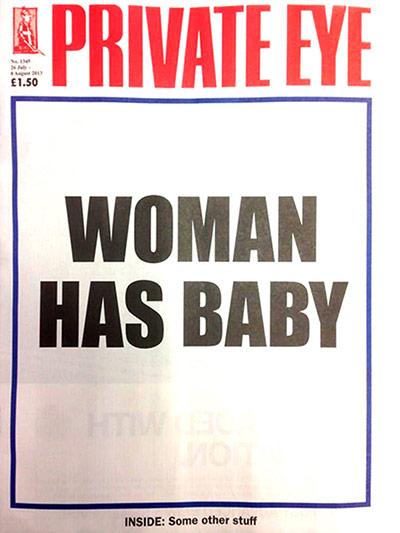 |
| Private Eye's front-page coverage. Brilliant. |
There are a few things that are genuinely saddening about this media-induced fervour. Firstly, when you look on a crowd of people waiting outside Buckingham Palace, you can almost know for certain that these people wouldn't do the same even for a friend's childbirth, such is the power of media nonsense. Do these people really care about a baby that has just been born into an archaic, deeply unfair system? If so, why? I would submit that it is almost entirely media fabrication. 'Care, care, care!' the papers scream, lest you look like some sort of social terrorist. 'Just fit in!' I think most people go along with it without questioning what the hell they're subjecting themselves to, and what their incurious (spellcheck suggested 'injurious', a word that would fit with equal ease) decisions say of their whole being. I do not think it is exaggerative to say that the media is responsible for whipping up interest where it would not have existed to an even comparable degree.
What is interesting, but deeply unsettling, is that in the past monarchs have had to maintain a huge reserve of force to legitimate their reign. Nowadays, in the world of the internet and mass media, the monarchy has become a branding exercise. Why is this worse? Well, a monarch that can best manage an army is a monarch that can best defend the country, and in this way they perhaps deserved in the past at least some of their position. Presently, however, the royal family secures its future position with what is effectively deception, as all branding is. It is propagating the idea that a population needs something more than it really does. It is incredible, simply incredible, that our current royal family has such support from the public (though I do not pretend it is quite as strong as the media might have you believe). They contribute nothing to the people by whom they are largely funded. The poor souls of this country pay for a family to live in a palace. They actually have to be paid to submit themselves to such degradation. The whole thing is farcical. Worse, they are completely unelected and nobody seems to mind.
And then you have David Cameron taking it upon himself to decide that the whole nation 'will celebrate'. How loathsome. I wouldn't particularly mind others celebrating the birth of this child (one of the correspondents on BBC News said 'Kate has given birth to a young child,' as if she might have given birth to a 43-year-old Bulgarian window cleaner), but I cannot tolerate others telling me that I must titillate myself in glee. 'Nobody's got any money, most people can't afford to have fun, the world's about as hostile as it has ever been, but an ancient mechanism for oppression and greed has just been perpetuated. Wooooooo!'
It is the ideas underpinning this unquestioning acceptance of the royals that are most damning. It says the people of this country do not mind a deeply unequal society, and the monarchy is the keystone in the idea that it's OK for some people to live comfortably by exploiting others. It says we do not mind the deification, the beatification, the media wants us to bestow on the unworthy. I would suggest that to agree that these people are better through a happy accident of birth is the ultimate in self-abasement. It is an acceptance of one's own servility, in fact a resignation to it, and furthermore a rejection of talent or endeavour. I do not need to tell you that this is toxic to society and the individual alike.
Why else do I despise this simulated interest in the royal hatchling? I alluded to it earlier, but it is this: there are already people in everyone's life, real people with whom we actually have spoken, it can be guaranteed, who deserve more attention than they receive, and it is tragic that they are not praised because they are not in the media. Don't worry about babies you will never meet, whose lives are blessed by virtue of no virtue at all. Celebrate what's real and take an interest in someone the papers haven't told you to take an interest in. The Duke and Duchess of Cambridge don't care about you, won't be at your wedding, won't send you a Christmas card, and you should return the favour. Think for yourself and decide who is more deserving of your time - royalty in palaces, promoted to a mystical celebrity status, or friends.
Monday, 8 July 2013
On Grammar Nazism
It is too hot. I do not refer to a subject in that sentence because I don't feel I need to reference one. Everything is too bloody hot. I do not appreciate the sensation of being sautéed, much less without judicious seasoning. And so the nonsense has already begun to emerge. I can't help it. Anyway, the heat today is such that I am occupied only by imagining waxwork exhibitions around the country being reclaimed by force by nature, Simon Cowell's oblong bonce bubbling and weeping to the ground in a cascade of simulated flesh, followed swiftly by his liquified mammaries as feckless museum staff rush to recover the atrophied mass. This is all perhaps a hyperbolic assessment of the weather but I feel it accurately describes my own state of discomfort.
It is the anger precipitated in me by this heat that leads me to the savage tirade that is about to ensue. This is a topic that has been clawing at my insides for quite some time and it, perhaps wrongly, continues to disgust me in the greatest way possible. The phenomenon is that of the ruthless grammatical pedant. It even has a popular term now, and the Grammar Nazi movement boasts a huge membership. I will propose in this blog post that these people can all go and, for want of a better expression, fuck themselves (or as Christopher Hitchens so elegantly described this phrase, 'attempt an anatomical impossibility.')
I cannot possibly recall how many times I have seen arguments - naturally on the internet, where one is granted a certain degree of both anonymity and physical distance - which run smoothly and appear to be coming closer to an approximation of truth, when someone will misspell something or make a mistake with a completely insignificant piece of grammar and will be absolutely pilloried for it. I cannot describe how speedily this infuriates me. Correcting someone's grammar in this way, with the wicked intent to generate embarrassment, is seen as socially acceptable. People for some reason think it either validates their argument, or rather devalues their opponent's, or creates comedy. It does neither. In fact, the ridiculous incursion of grammar into every fucking argument has precisely the reverse effect on the buffoon who feels their argument is so poor that they must make recourse to grammatical, personal jibes. Their argument suddenly looks anaemic, in need of extraneous aid, and their disposition is highlighted as one lacking humour, creativity, tolerance, or disobedience.
Perhaps one reason for my abomination of this blasted habit in argument is that I don't like to be criticised. This perhaps is true, though I rarely voluntarily sit in the company of people liable to deploy this non-sequitur. The inference is what really aggravates me - the inference is: 'Your grammar has failed, therefore the reason behind your argument is undermined.' I fail to see the logic here.
An additional reason for my hatred is that I cannot bear to be corrected, or see someone corrected, by someone else who is not at all perfect in the subject they so mightily preach on. This is sanctimonious, greasy foul play. People should not have to feel that a typo, or even deliberate error, will derail an argument.
More importantly than this - who cares? Why does it matter that your adversary omitted an apostrophe? Argument is not an editorial submission; at least, not an editorial submission with regards to grammar. The focus of an argument should be on the underlying principles. As long as you can marshal your thoughts in a comprehensible way then you should not be penalised. In trifling debates on the internet, grammar should not determine truth.
I don't think grammar has ever been as zealously praised as it is today, and I've lost count of the amount of letters or manuscripts of past poets' works I've seen that have omitted apostrophes and such. Perhaps it bespeaks fault on my part but I don't find this offensive and I don't judge any party for it. I make reference to him in every blog post but I'm not tiring of it so I'm going to recidivate... Byron was one of the most literate people who ever lived and he very frequently abbreviated or omitted punctuation in his letters. This was done largely for economy - it was expensive to send long letters in the 1800s (a state we are returning to...) and grammar could easily be compromised if meaning remained intact. This is analogous to Twitter with its character limit. And this brings me to a similar point, which is that some people patrol Twitter in the most pathetic way imaginable, trawling through tweets and highlighting poor grammar for 'comedy'. I follow, or rather did follow, someone who used to enjoy doing this, who said he 'searched for common spelling and grammar errors' for material. I found a great empathy for an existence as tragic as his must be. To highlight a grammatical error in an argument is one thing, but to spitefully do this on Twitter, which is itself a place for nonsense and frivolity, is quite another.
Here we reach a crucial point which is ineluctably damning for the advocates of - actually, I refuse to refer to invoke its idiotic appellation any longer - Grammar Land jingoism. Namely, does poor grammar, through mistake or otherwise, indicate a lesser intellect? If yes, then you are simply mocking those above whose intellects you would place your own, which is malice. There is no place for malice in equanimous debate, and a lesser mind does not necessarily mean lesser beliefs besides. If no, then why bother to bring the point up at all? It cannot possibly outline a weakness in the argument's author.
I could go on about this for too long, but I feel I would be emulating the misplaced ardour against which I fulminate. Correcting grammar to win an argument is counter to promoting reason, and correcting grammar for no reason besides maleficence is counter to promoting kindness. This habit calls upon all of man's worst vices - superiority, spite, sadism, and a desire to win at all costs. Do not mistake my position on grammar itself - it is useful in the same way as mathematical notation, but poor mathematical notation says nothing of the mathematical principles underpinning the work. I try to use good grammar when I can but I won't go out of my way to correct others in their use of it. To correct either ignorance or error is equally unkind. I am no editor and no teacher. And I certainly will not substitute prissiness for reason.
It is the anger precipitated in me by this heat that leads me to the savage tirade that is about to ensue. This is a topic that has been clawing at my insides for quite some time and it, perhaps wrongly, continues to disgust me in the greatest way possible. The phenomenon is that of the ruthless grammatical pedant. It even has a popular term now, and the Grammar Nazi movement boasts a huge membership. I will propose in this blog post that these people can all go and, for want of a better expression, fuck themselves (or as Christopher Hitchens so elegantly described this phrase, 'attempt an anatomical impossibility.')
I cannot possibly recall how many times I have seen arguments - naturally on the internet, where one is granted a certain degree of both anonymity and physical distance - which run smoothly and appear to be coming closer to an approximation of truth, when someone will misspell something or make a mistake with a completely insignificant piece of grammar and will be absolutely pilloried for it. I cannot describe how speedily this infuriates me. Correcting someone's grammar in this way, with the wicked intent to generate embarrassment, is seen as socially acceptable. People for some reason think it either validates their argument, or rather devalues their opponent's, or creates comedy. It does neither. In fact, the ridiculous incursion of grammar into every fucking argument has precisely the reverse effect on the buffoon who feels their argument is so poor that they must make recourse to grammatical, personal jibes. Their argument suddenly looks anaemic, in need of extraneous aid, and their disposition is highlighted as one lacking humour, creativity, tolerance, or disobedience.
Perhaps one reason for my abomination of this blasted habit in argument is that I don't like to be criticised. This perhaps is true, though I rarely voluntarily sit in the company of people liable to deploy this non-sequitur. The inference is what really aggravates me - the inference is: 'Your grammar has failed, therefore the reason behind your argument is undermined.' I fail to see the logic here.
An additional reason for my hatred is that I cannot bear to be corrected, or see someone corrected, by someone else who is not at all perfect in the subject they so mightily preach on. This is sanctimonious, greasy foul play. People should not have to feel that a typo, or even deliberate error, will derail an argument.
More importantly than this - who cares? Why does it matter that your adversary omitted an apostrophe? Argument is not an editorial submission; at least, not an editorial submission with regards to grammar. The focus of an argument should be on the underlying principles. As long as you can marshal your thoughts in a comprehensible way then you should not be penalised. In trifling debates on the internet, grammar should not determine truth.
I don't think grammar has ever been as zealously praised as it is today, and I've lost count of the amount of letters or manuscripts of past poets' works I've seen that have omitted apostrophes and such. Perhaps it bespeaks fault on my part but I don't find this offensive and I don't judge any party for it. I make reference to him in every blog post but I'm not tiring of it so I'm going to recidivate... Byron was one of the most literate people who ever lived and he very frequently abbreviated or omitted punctuation in his letters. This was done largely for economy - it was expensive to send long letters in the 1800s (a state we are returning to...) and grammar could easily be compromised if meaning remained intact. This is analogous to Twitter with its character limit. And this brings me to a similar point, which is that some people patrol Twitter in the most pathetic way imaginable, trawling through tweets and highlighting poor grammar for 'comedy'. I follow, or rather did follow, someone who used to enjoy doing this, who said he 'searched for common spelling and grammar errors' for material. I found a great empathy for an existence as tragic as his must be. To highlight a grammatical error in an argument is one thing, but to spitefully do this on Twitter, which is itself a place for nonsense and frivolity, is quite another.
Here we reach a crucial point which is ineluctably damning for the advocates of - actually, I refuse to refer to invoke its idiotic appellation any longer - Grammar Land jingoism. Namely, does poor grammar, through mistake or otherwise, indicate a lesser intellect? If yes, then you are simply mocking those above whose intellects you would place your own, which is malice. There is no place for malice in equanimous debate, and a lesser mind does not necessarily mean lesser beliefs besides. If no, then why bother to bring the point up at all? It cannot possibly outline a weakness in the argument's author.
I could go on about this for too long, but I feel I would be emulating the misplaced ardour against which I fulminate. Correcting grammar to win an argument is counter to promoting reason, and correcting grammar for no reason besides maleficence is counter to promoting kindness. This habit calls upon all of man's worst vices - superiority, spite, sadism, and a desire to win at all costs. Do not mistake my position on grammar itself - it is useful in the same way as mathematical notation, but poor mathematical notation says nothing of the mathematical principles underpinning the work. I try to use good grammar when I can but I won't go out of my way to correct others in their use of it. To correct either ignorance or error is equally unkind. I am no editor and no teacher. And I certainly will not substitute prissiness for reason.
Wednesday, 26 June 2013
The Paradox of Industry
You may, if you care, which itself would grant you membership to a very elite group, have noticed that I haven't posted anything for a week or so. This has not been a contrived endeavour on my part, in fact it has been due to the absence of such an endeavour. I've discovered, since returning home a fortnight ago, an ungovernable torpor which has left me unable, unwilling, unwhatever to write much at all. As it happens, I decided quite some time ago to write about writer's block and I have, in a display of grandest irony, been unable to complete it.
Fortunately, an hour's perusal of Twitter generously endows one with ideas, and is as efficacious as anything you could care to mention in restoring my unfaith in humanity. This has gone some way in placating the gaping abysm of creative desolation into which I am happily lodged. Hopefully, therefore, I will be able to moan about something fairly soon.
But enough self-indulgence, I must apprehend the crux of this post. What I have found to be true in this span of unimpaired leisure is that industry is exponentially harmed by any gift of free time. I have always suspected this to be the case but my summer holidays affirm it. This may be a rule true only of myself, but this does not diminish its claim to being a rule. I find I will complete far more, write far more, enjoy myself far more, when all this is tempered by unpleasantness. I recall writing a lot during sixth form, from 1am onwards when I had to be up at 8am, which fact oppressed me greatly. It is only against the backdrop of something toilsome that leisure can be efficiently appropriated. Now I have no countervailing force against which I should rebel, and this somehow removes most of the point of writing anything in the first place. At university there is a kind of sour joy to be had from missing a day's lectures to relay a soldier's experience of how shit the whole arrangement is. Prioritising writing before coursework provided a similar simulation of sybaritism and debauchery. Now I am, as a teacher might remind me, only wasting my own time. Wasting others' is far more enjoyable.
I do not merely propose that excessive spare time reduces output per hour of spare time, but that it may reduce total output itself. Certainly I have done a lot less in the last two weeks than I usually might, but I've also strangely derived less pleasure from this. I do not much savour the hours I spend in my pyjamas, watching television shows that I would, under normal service, vomit at the sight of. I cannot understand why I prefer to do boring things than interesting things, when both are as accessible. A sort of anti-utilitarianism seems to reign in my head when I'm given enough spare time.
Clearly, though, this cannot be a universal truth - this would imply that less can be accomplished in an infinite time frame than in a nonexistent one. But I do think there is an optimal balance between work and leisure. Furthermore, as I described in my last post, a large amount of the creative output of the past few hundred years has been the progeny of a life of leisure. This said, we do not know what could have been produced had these idle writers been afflicted with greater hardship. I can create things when I have a lot of free time, but there is no sense of urgency.
I suppose it can be said that leisure is a great milieu for thought, but I find that too much leisure produces too much thought. Sometimes I envy the feral nonchalance with which an animal can drift through the world, programmed as they are merely to find the next meal. Human minds are like furnaces, things need to constantly be poured into them or they will collapse under their own ferocity. If the mind cannot deconstruct something external then it will look into itself and begin to mess around with levers and switches that are best left alone. A mind will eat an arm if it must do so to survive. Leisure gives too much time and too little to use it for. So too much leisure is bad in this respect.
Anyway, the point I wish to make from all this is: sometimes there can be too much of a good thing. Excessive leisure may not be quite so deleterious to others, but I find it removes any sense of struggle. I like being irritated, and this often compels me to do things I do enjoy, and this is not so viable when I am the cause of my own boredom (though I have made a good attempt at it in this post).
Fortunately, an hour's perusal of Twitter generously endows one with ideas, and is as efficacious as anything you could care to mention in restoring my unfaith in humanity. This has gone some way in placating the gaping abysm of creative desolation into which I am happily lodged. Hopefully, therefore, I will be able to moan about something fairly soon.
But enough self-indulgence, I must apprehend the crux of this post. What I have found to be true in this span of unimpaired leisure is that industry is exponentially harmed by any gift of free time. I have always suspected this to be the case but my summer holidays affirm it. This may be a rule true only of myself, but this does not diminish its claim to being a rule. I find I will complete far more, write far more, enjoy myself far more, when all this is tempered by unpleasantness. I recall writing a lot during sixth form, from 1am onwards when I had to be up at 8am, which fact oppressed me greatly. It is only against the backdrop of something toilsome that leisure can be efficiently appropriated. Now I have no countervailing force against which I should rebel, and this somehow removes most of the point of writing anything in the first place. At university there is a kind of sour joy to be had from missing a day's lectures to relay a soldier's experience of how shit the whole arrangement is. Prioritising writing before coursework provided a similar simulation of sybaritism and debauchery. Now I am, as a teacher might remind me, only wasting my own time. Wasting others' is far more enjoyable.
I do not merely propose that excessive spare time reduces output per hour of spare time, but that it may reduce total output itself. Certainly I have done a lot less in the last two weeks than I usually might, but I've also strangely derived less pleasure from this. I do not much savour the hours I spend in my pyjamas, watching television shows that I would, under normal service, vomit at the sight of. I cannot understand why I prefer to do boring things than interesting things, when both are as accessible. A sort of anti-utilitarianism seems to reign in my head when I'm given enough spare time.
Clearly, though, this cannot be a universal truth - this would imply that less can be accomplished in an infinite time frame than in a nonexistent one. But I do think there is an optimal balance between work and leisure. Furthermore, as I described in my last post, a large amount of the creative output of the past few hundred years has been the progeny of a life of leisure. This said, we do not know what could have been produced had these idle writers been afflicted with greater hardship. I can create things when I have a lot of free time, but there is no sense of urgency.
I suppose it can be said that leisure is a great milieu for thought, but I find that too much leisure produces too much thought. Sometimes I envy the feral nonchalance with which an animal can drift through the world, programmed as they are merely to find the next meal. Human minds are like furnaces, things need to constantly be poured into them or they will collapse under their own ferocity. If the mind cannot deconstruct something external then it will look into itself and begin to mess around with levers and switches that are best left alone. A mind will eat an arm if it must do so to survive. Leisure gives too much time and too little to use it for. So too much leisure is bad in this respect.
Anyway, the point I wish to make from all this is: sometimes there can be too much of a good thing. Excessive leisure may not be quite so deleterious to others, but I find it removes any sense of struggle. I like being irritated, and this often compels me to do things I do enjoy, and this is not so viable when I am the cause of my own boredom (though I have made a good attempt at it in this post).
Subscribe to:
Posts (Atom)